How and Why to Be Healthy

In today’s world it is so important to be healthy. Doctors, scientists, researchers, and engineers all collaborate to make our medicine topnotch. The helpers for our body are doing their part. These advances in technology have done their share, leaving the rest to us. Now, it’s our turn to treat our body the way it should be treated.

How?

Step 1: Know the Fact and Statistics

  • 1 in every 4 deaths are due to Heart Disease in America
  • 49% of Americans have either diabetes, high blood pressure, or smoke, all key risks for heart disease
  • Every 34 seconds an American has a heart attack
  • 8.3% of the American population has diabetes
  • 41% of Americans will be diagnosed with some stage and type of cancer

Don’t let your body become a part of one of those percentages.

Step 2: Keep Healthy Snacks

Try to keep healthy snacks in your backpack or purse during the day. For example, you could keep a granola bar or fruit. This will give you enough energy to last in-between meals. Sugary snacks (like chocolate) will do that too, but it isn’t a healthy choice.

Step 3: Healthy Grocery Shopping

Make a list of healthy ingredients. Go online and find some recipes you’ll enjoy. You know your taste buds the best. When going down the aisle, try to avoid picking up things like candy and chocolate. Instead, pick a replacement. Maybe instead of getting your weekly dose of chocolate you could pick up raspberries! However, if you really do need that weekly dose, you could try to have a dessert that involves fruits and sweets. For example, I recently made a delicious dessert. It’s called “Caramel Apple Dessert Salad”. It consists of cut apples in the shape of a cube, caramel sauce, chocolate sauce, heath bits, chocolate chips, white chocolate chips, and pecans  (optional). It tastes delicious, and it’s not too bad for you! You can’t feel too guilty about eating it since there are apples. Apples reduce cholesterol,  detox your liver, and boost your immune system, and all while protecting against Alzheimer’s diseases and Parkinson’s disease! Try filling strawberries with Nutella or cheesecake filling. That way, your sweet craving will be satisfied while gaining essential vitamins and nutrients! Strawberries also boost short-term memory, lower cardiovascular disease, and strengthen bones! You could buy celery sticks and dip them in peanut butter! Celery is one of the healthiest snacks. Celery is a great fiber supplement, and even helps with arthritis and spleen and liver diseases.

Step 4: Drink Water

Water, water, water! Water helps balance other fluids in the body, helps control calories, energizes your muscles, keeps your hair strong, keeps your skin healthier, maintains your bowel functions, increases cognitive function, and helps maintain strong and sturdy joints! Water is an essential part of your diet! Make sure to drink about 8 cups a day. Avoid soda and other drinks with a lot of sugar. If you are having a lot of juice, try added 1/4 or 1/2 a cup of water! Soda increases your chance of obesity, increases your risk for diabetes, increases your risk of having a  heart attack and stroke, and of course contributes to the decay of teeth enamel.

Step 5: Set Goals

Setting goals will motivate you. No one ever wants to disappoint himself or herself; that is one of the worst feelings. Set goals for yourself that you know that you will be able to be successful in. You are the only person who knows your body, your stamina, and your metabolism. Try monthly goals at first. For example, this coming month set a goal on running at least twice a week. While doing that monthly goal, also set weekly goals. For example, your weekly goal could be purchasing healthier groceries. Try daily goals, like talking a walk everyday or doing sit-ups in the morning.

Step 6: Have a Friend/Family Member to Start With- Have a Motivation

When starting this new lifestyle, try finding a gym-buddy! Maybe go grocery shopping with someone, so when you reach for the ‘Flaming Hot Cheetos’ and powdered doughnuts someone will stop you! By starting this chapter of your life with someone, both parties will be motivated. It’s a win-win situation. The positive reinforcement and encouragement will also make your ability and will power to change your lifestyle in a positive and healthy way. Try providing incentives for each other.

Step 7: Exercise

Exercise just simply makes you feel better. If you’re not much of a gym-goer you still have many options! For example, there’s yoga, which is a great alternative. Yoga balances out stress hormones, strengthens your cardiovascular system, and speeds up your metabolism. It might even be better than going to the gym! Yoga also strengthens your cardiovascular and muscular system as well as your posture. The great thing about yoga is that anyone can do it! Exercise gives you the time to reclaim your emotional stability as well as your mental and physical health. The key is to deep breaths while coordinating those breaths with the motions of your body. There are many different types of yoga positions. Some require sitting, some reuire standing, some require flexibility and some don’t. You can do yoga anywhere- you can take a class at a gym or you can do it in your own backyard looking over a view. You could even take a walk around your neighborhood or around your office building during your lunch hours. There are a lot of options and you can get very creative!

(https://copingwithcancerforkids.wordpress.com/2013/07/08/coping-strategy-2/

Step 8: Relax

Relax. If you’re having a busy day, and it’s convenient to pick up fast food, so be it. I understand that McDonalds and frozen meals have programmed themselves to taste better, even if that means the food is ten times unhealthier. Having fast food once in a while is totally okay.  Don’t deprive yourself of things you love. Take everything step by step and do something for yourself. Don’t kill yourself over a healthy lifestyle. If you want to get dessert every other weekend, then do it! Do what makes you happy. Always be kind to yourself.

Step 9: Get Enough Sleep

Sleep plays a huge role in one’s metabolism. Getting the right amount of sleep makes learning new things and memorizing much easier. It also helps stabilize your metabolism and blood pressure. Your irritability and mood swings significantly decrease. Sleep keeps your cardiovascular system and immune system healthy as well. By getting the full 8-10 hours of sleep each night, your irritability and mood swings decrease. You will wake up feeling refreshed and ready to take on the day.

(https://copingwithcancerforkids.wordpress.com/2013/07/23/coping-strategy-3-sleep-2/)

Step 10:  Be Healthy Around Family/Friends- Be a Motivation

Make yourself become a motivation to someone! Be a healthy role model. Everyone wants a healthy lifestyle, it’s just about being able to start it and keep up with it. Show everyone that you did it. Inspire someone. Tell your friends, “If I can do it, so can you!” Be a motivation not just towards your friends, but family, colleagues, and everyone in your circle!

Why? 

In my situation, cancer, diabetes, and heart problems are running through my blood.  I want to be able to live a comfortable life, not worrying about my health and risks constantly. By starting now, I hope to achieve that. I know a lot of people are in my situation. Genetics has a play in diabetes, heart disease, cancer, and many other scary and deadly diseases. However, by taking the right steps, you can always have a leg up and be one step ahead of the never-ending race.

New Year’s Resolutions

Happy New Year! I know that this post is about 8 days overdue and I apologize.

With a sick or lost parent, there is always something to do. And with those things to do comes potential improvements. Here are some ideas that might help you get through this cancer-stricken year!

New Year’s Resolutions for cancer patients:

  • Gain healthy weight- I know that with chemotherapy and the stress of cancer it is natural to lose weight. But remember, you must be strong for your next round of chemotherapy! Try to gain healthy weight. For example, try having Full-Fat Greek Yogurt with lots of fruits as many times a week as possible.
  • Tell your family what’s going on- Your family is there to help you and they genuinely want to. Don’t hide your diagnosis and doctor’s appointments from anyone.
  • Ask your doctor- If you don’t understand what your doctor is saying or if you want more details, just ask. I know many cancer patients don’t know how to ask certain questions about their diagnosis and prognosis, but always remember that oncologists want to help you. Also, don’t feel bad to get a second opinion.

New Year’s Resolutions for those coping with a loved one’s cancer:

  • Do something for yourself- Treat yourself to something nice every now and then because you deserve it. Cancer is beyond hard to deal with. Without giving yourself a break, you will start to resent your situation.
  • Take care of yourself- I know how busy you are taking care of your sick loved one, but don’t forget to take care of yourself! Eat right and exercise well. Stay healthy for your parent(s)!
  • Volunteer- Being able to volunteer with cancer organizations is so fulfilling. I highly recommend it to those coping with this deadly disease.

To both groups:

  • Join a support group- Join a support group and ask for help. You will meet many others who are in a similar situation. You will feel less alone, you will be able to vent in a healthy way, you will meet people who finish your ______. (sentences)
  • Talk about your feelings- Tell your family how you feel and how much you love each other. This life is too short for you not to say, “I love you.” every single day.
  • Save someone- You know what cancer does to a family. You have seen the ups and downs of it. Save someone and make sure they get their screenings and tests when required.
  • Be positive- Don’t fret over things that are not in your control. People are going to say insulting things about cancer. People are going to insult the way you are coping with your cancer story. Walk away because you don’t need anymore negativity in your life. Surround yourself with positivity and do the best you can do while coping with cancer.

The Holidays

The holidays with a sick parent or a recently deceased parent is undoubtably challenging. In my opinion it is one of the hardest times throughout the year.

Cancer Christmas Tree

Here are some tips that will help you get through this time:

  • Start a new tradition- Because of cancer, you and your family might not be able to do everything you used to before the cancer. Start a new tradition. Maybe you could make cancer ribbons and hang them on your Christmas tree!
  • Be a giver- After my experience with cancer, I have become so thankful and grateful for the smallest things in life- thankful and grateful for things most teenagers won’t even realize we are blessed to have.
  • Do something for yourself- It is the holiday season! Just because you are dealing with this obstacle, does not mean you are not allowed to have fun and celebrate the holidays.
  • Tell your family/friends if you do not feel like participating in certain things- Even though you should be having fun and celebrating everything, it is totally understandable if you don’t feel like it. Remember, no one expects anything. If you are not in the mood to go do something, then don’t. This time of the year is hard with a sick parent or a deceased parent and most people understand that.
  • Don’t expect much- In whatever situation you might be in, it is natural for cancer and everything that comes with cancer to dictate many family decisions. Do not expect too much out of your sick or healthy parent. They are trying their best to please you during this hard time!
  • Set goals- With New Years coming up, I suggest setting goals. Set goals about cancer. Maybe your goal will be taking your parent to a certain number of chemotherapies or maybe it will be honoring a parent who passed away from cancer in a new and creative way. My cancer related goal is to help a certain number of kids and teenagers who are having trouble coping with their parent’s cancer.
  • Spend time with your family- After having cancer play such a big part in your life, I am sure you understand how important it is to spend time with your family. So, spend as much time with your family as you possibly can!
  • Keep the holiday spirit- Cancer does not define you or your family. Make sure to have fun and still keep the holiday spirit going, despite these stumbles.

Happy Holidays! I hope everyone has a great holiday season while coping with cancer the best one could!

Coping Strategy #8

Group Therapy!

Group therapy is a great option if you don’t feel comfortable talking to a specialist one-on-one. Group therapy is also much more affordable. Humans are social beings. It’s easy to talk to one another in a group. Also, in group therapy you will feel more secure and less alone compared to alternative treatments. You see other kids dealing with a similar situation. When you start telling your story, the group members will understand your problem and relate to it. Having so many perspectives listen to your story, may even change your perspective in a positive way! After saying your feelings in this group, it will be much easier to communicate with your friends and family on this topic as well.

I have heard great things about group therapy and I recommend it for those who are ready to seek help! Stay positive!

Great American Smokeout

Today is the Great American Smokeout, which was started by the American Cancer Society! The Great American Smokeout is a day where those who smoke, are pushed to take the next steps to quitting. As mentioned in my previous blog post, smoking increases the risk of being diagnosed with Lung Cancer. Smoking also harms those around the smoker through second-hand smoking.

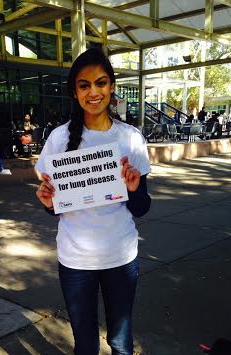
This year, I was blessed to be able to participate in the Great American Smokeout. Students spread themselves out through the central area of campus and held up facts about smoking. It was apparent that such a small gesture made a positive impact on campus.

"Quitting smoking decreases my risk of lung cancer."

“Quitting smoking decreases my risk of lung disease.”

I strongly recommend sharing this post (and the previous post) with those who smoke or with those who have a smoker in their family. Quitting this terrible habit for even one day will benefit the smoker’s body immensely. Happy Great American Smokeout Day!

For more information about the Great American Smokeout visit: http://www.cancer.org/healthy/stayawayfromtobacco/greatamericansmokeout/index

National Lung & Pancreatic Cancer Awareness Month

November is National Lung Cancer Awareness Month and National Pancreatic Cancer Awareness Month! During November, cancer organizations put on events to help fight these diseases and raise funds for research.

Here are a few facts about Lung Cancer to raise awareness:

  • When it comes to cancer deaths, Lung Cancer takes the lead.
  • More men than women are diagnosed with Lung Cancer every year.
  • Active smoking is responsible for 90% of Lung Cancer patients.
  • If one is exposed to second hand smoke on a daily basis, their risk for Lung Cancer increases from anywhere between 20-30%.
  • Those who work with cancer causing agents, such as asbestos, arsenic, and radon, are also at a higher risk of being diagnosed with Lung Cancer.
  • Lung Cancer is often diagnosed through a lung biopsy, sputum cytology, bronchoscopy, mediastinoscopy, thoracentesis, CT scan, or PET scan.
  • Like most cancers, Lung Cancer can be treated though surgery, chemotherapy, and radiation.

Here are a few facts about Pancreatic Cancer to raise awareness:

  • Unfortunately, Pancreatic Cancer has a low survival rate compared to other types of cancer.
  • Family history of this disease, smoking on a regular basis, consuming alcohol on a regular basis, having a poor diet and having diabetes are major risk factors for this deadly disease.
  • Pancreatic Cancer is usually diagnosed through a physical exam, biopsy, ultrasound, MRI, or an X-Ray.
  • Pancreatic Cancer can be treated through surgery, chemotherapy, radiation, immunotherapy, and gastroenterology.

Share these facts about Lung & Pancreatic Cancer with your friends and family to spread awareness and to help prevent these diseases. These types of cancer are extremely deadly, painful, and scary. It is so important that everyone is well-informed about the major facts. Always remember to support all types of cancer throughout the whole year! We are all in this fight together.

Looking at Before and After Pictures

One of the hardest things while coping with this awful sickness is looking back at pictures from the time your parent did not have cancer and immediately noticing the changes that the disease has brought on. It’s hard seeing that transition of your own parent from a healthy and active person to a cancer-stricken patient.

When I look at recent pictures of my dad, I see the cancer in him. I see the wrinkles that came in the last two years; I see the defined cheek bones and sunken-in eyes due to the weight loss; I see the peeling hands and feet from the chemotherapy; I see the cancer. To protect myself from more pain, I try not to look at those.

It’s especially hard because if you lost your parent (or loved one) to cancer, your most recent and vivid memories are petrifying. You remember the weakness, the throwing up, the change of temper, and all the other chemotherapy affects.  As difficult as it is, it is so important to remember your loved one in a healthy form. It’s going to be a struggle rewinding to a couple years ago, but it will be a healthier way of grieving (or dealing with this new change in your life). Always remember that cancer doesn’t define a person. Stay positive and spread smiles!

Coping Strategy #7

Therapy!

Having a sick parent is tough. It’s also frustrating, sad, chaotic at times, depressing, scary and much more. It’s hard to cope with all of those feelings, while living a life. It’s also a challenge to keep those feelings separate from your school and social life.

I highly suggest talking to someone. It’s too unhealthy to keep all those negative feelings bottled up. Therapy is a great option to let it all out. Saying your feelings outloud to a specialist will help you feel better and more secure. I’m also sure that your parent’s oncologist knows of programs you can join or someone to talk to. You could also talk to your school counselor or any teacher. For that matter, you could talk to any adult that is willing to just listen! Talk to your friends if you don’t feel comfortable talking to an adult. Just talk to someone! You will feel better afterwards.

If your parent is in the hospital or under Hospice Care, they will have social workers for you! If they haven’t already reached out to you, give them a call and see what they can offer to you. Some insurances also cover a few free therapy sessions, so check that out as well.

Therapy can be time-consuming and challenging at times, but the outcome is worth it. Remember to do your research about the therapists near you if you plan on seeking that help! Stay positive!

National Breast Cancer Awareness Month

It’s October which means it is National Breast Cancer Awareness Month! National Breast Cancer Awareness Month (NBCAM) was created in 1985 to not just raise funds for Breast Cancer research and those fighting it, but to spread awareness. Now, every October cancer organizations put on major events to raise money and spread awareness for this disease.

A few facts about Breast Cancer to raise awareness:

  • Cancer can potentially spread through tissue, blood, and the lymph system. Therefore, it is important to get a PET scan, CT scan, MRI, Ultrasound, or Lymph biopsy if a Mammogram shows a tumor.
  • For those who don’t know what a Mammogram is, it’s an X-Ray of the breast. Although it may have slight radiation, the importance of this screening outweighs the extremely minor effect.
  • Women of 40 years or older should start getting a Mammogram about once every 1-2 years. However, Breast Cancer can be genetic. If you are aware of any family history regarding this disease, health care providers strongly recommend getting the screening done before age 40.
  • Breast Cancer occurs in 1 in every 3,000 women who give birth, mostly in the ages between 32 and 38 years.
  • About 1% of Breast Cancer victims are males and usually between 60-70 years old. Males (like females) can be diagnosed with Breast Cancer at any age. Biopsies, Ultrasounds, MRIs, physical exams, and blood tests are usually the way males test for Breast Cancer.
  • Common treatments include: Surgery, Chemotherapy, Radiation Therapy, Hormone Therapy, and Target Therapy.

I think it is so important to be well educated on not just cancer, but all diseases. I hope this helps you in some way or form. Remember to stay positive and not just support Breast Cancer this month, but all types of cancer throughout the year!

The Pros

When you first find out that you have a sick parent or relative at such a young age, your first thoughts are probably not the best. You might be scared your parent’s life will be coming to an early end. You might be mad at doctors for the diagnosis and even your parent for getting sick. You might feel lonely because most people don’t understand what you are going through and the extent of your pain.

One day you will start looking at the bright side of things. Here are just a few things I discovered when my dad was fighting cancer:

  • I started understanding what sick people are actually going through. Minor or major illness, my respect for cancer patients is extremely high.
  • When I was 16 years old, often times I had to act and think like a 36 year old. I matured to a degree that some adults are not even at yet.
  • My family and family friends really came together at tough times. It’s sad that the time I saw my family most was during a hard time, but I am so thankful for the support. Now, I know I can go to my family or family friends for anything.

One day you will come across some of these realizations, and maybe even more. Try to look at the bright side of every situation and spread the positivity among your family and friends.

Cancer Does Not Mean Death

Throughout my blog, I have mentioned the death of my father. However, I would like to make it very clear to my readers that cancer does not mean death. Cancer survival rates depend on many things such as the diagnosis, prognosis, treatment, and so much more. I strongly believe cancer survival rates shoot up with positivity, hope, and faith within the whole circle of family and close friends. I also believe the reason my dad did so incredibly well during his first year and a half of chemotherapies was because of the positivity not only that he had, but every single one of our close friends and family members had.

When my dad was diagnosed with cancer, death crossed my mind multiple times. It’s like you’re always living in fear. It’s also completely normal to have these thoughts. You always think that you’ll come home from school one day and your parents will sit you down and tell you that the treatments aren’t working as well as they should be. I always tried not to think about it and stay in high spirits through the thick and thin. If it started creeping through my head, I would start thinking about how my dad was such an amazing person and an amazing person like that doesn’t deserve death at a young age. But then again, no one deserves death at any age.

Try not to think about the future so much. Focus on the present. Do everything you can to help your parent get through this. Even if it’s the smallest deed, like just sitting there with them during a chemotherapy session while they fall asleep would help them immensely. Being happy around a sick person helps an infinite amount, trust me.

Sometimes we have to put ourselves in our parent’s shoes. Of course my dad never wanted to see me cry. He never wanted me to think that his cancer was stopping my life. He hid his pain from his loved ones around him, especially myself, my mom, and my sister. He didn’t want to be a burden. No sick person does. So, be elated around them. It’s truly a win-win situation and it will help their prognosis. Fight the cancer with your parents and spread the positivity within your circle- don’t let death be associated with your cancer story.

Coping Strategy #6

Go to Sleep Happy!

Like I mentioned in blog posts before, sleep is very important! Everyone just  performs better at daily tasks with their full amount of sleep. I think it’s really important to go to sleep happy (or as happy as you can be under the circumstances). Before you go to sleep, think of atleast three things you’re thankful for. I recently started doing this and it’s been helping me.

If someone made you unhappy that day, try to let it go or even confront them to get it off your chest. Finish all your goals for the day to feel accomplished and ready for the next day.

Go to sleep in a positive mood. Don’t fret over the little things. Be thankful for what you have. Sweet dreams!

Getting Through the Day

Sometimes when I wake up in the morning I feel like laying in bed all day and just looking at pictures of my dad and crying.  And sometimes during the day I feel like crawling into bed and doing the exact same thing.

Here are just a few things that get me through the day:

1. Knowing my dad is watching over me- I know that whatever I’m doing is making my dad happy. He wouldn’t want me to completely stop my life and sit home and sulk. As much as I would like to do that, it’s important for me to grieve in a healthy way.
2. Connecting my dad to every part of my day- I love celebrating my dad’s life and bragging to everyone on how cool and loveable he was. If I was in a conversation with someone I feel comfortable with, there’s a high chance I’ll bring up my dad and an amazing memory to go with the conversation. Talking about him with the right people makes me feel better, but not all teenagers are comfortable with that.
3. Doing it all for my dad- In my eyes, everything I do I do it for my dad. He’s my motivation in life. From the smallest goals to the largest tasks, I see my dad at the end of every destination.

Take everything step by step and day by day. Appreciate the little things in life. And of course, always keep your family as your number one priority.

Coping Strategy #5

Music!

Listening to music is beneficial. Having creative lyrics to listen to helps find yourself and explain those feelings in a way that you could not have put in words. Not only is listening to music helpful, but writing music is a great creative outlet to help cope with hard circumstances. Music lowers stress and anxiety levels. The stress hormone, cortisol decreases with music, leading to a more positive mood and outlook on life. Through research many psychologists have found music therapy helps build self-esteem, confidence, and cognitive functioning.

My dad and I loved playing guitar together. I will always cherish the memories of us sharing our enthusiasm for the instrument. Over the last few years, my guitar madness has diminished as school took over my life. The few times I still play the guitar, it calms my emotions down and brings back amazing memories of my dad. Playing an instrument is therapeutic- you get to forget what’s happening with your parent’s cancer and you focus on your music.

Music is a great escape from the real world. It lets your brain take an imaginative route away from your parent’s cancer.

The Comparing of Grandparents

When you tell people you have a sick parent at the age of 12-18 years most people don’t know how to react, especially your friends that are the same age as you. Many of them will compare your parent’s diagnosis /prognosis to their grandparent’s because that’s how cancer touched their heart. I personally had a lot of problems with this. Although my heart truly goes out to anyone touched by cancer when their grandparent was the victim, often times children have a closer bond to their parents than their grandparents. Your friends are going to tell you, “I know what you’re going through. My grandpa/grandma had cancer.” They don’t know what you’re going through. You do not have to depend on your grandparents as much as your parents. You do not have the same bond with parents as your grandparents. (Unless you live with your grandparents, then I would understand how that is relatable.)

If your friends are telling you they know how you feel because of their grandparents sickness, just let them think that. This is not anything to worry about. They are just trying to help you and support you. You are going to come across many people who don’t understand you. Majority of your acquaintances  won’t even come close to knowing your pain, but know that everyone is trying to help you get through this. Don’t fuss over the small comments that make you upset. Instead, be thankful that people are trying to support you.

Do Something for Yourself

During the time my dad was sick, I was so busy taking care of him, I stopped taking care of myself. I realized I needed to start doing something for myself before I go crazy.

Having a sick parent is a lot to deal with, especially as a teenager. You already have other problems like, focusing on the SAT’s, relationship scandals, friend drama, and so much more. No matter what struggles you are overcoming it is important to do something for yourself. Take at least half an hour of your day to do something that makes you happy, genuinely happy. You could start a new hobby, learn a language, exercise, anything. You could go for a bike ride in your neighborhood or start an art project. Breathing exercises, yoga, meditation, and general exercise all help you relax. If you don’t have time to start a new hobby or do something for yourself, definitely do something that will help you relax. Try not to think about your cancerous stricken parent for half an hour of your day. Take your mind off the stress cancer brings. As hard as it is to forget something that big, you have to remember you have your whole life ahead of you and this is just the beginning of all the curve balls life will throw at you. It’s important to learn how to cope with these curve balls by doing something for yourself!

Life Changing Moments

After my dad accepted his life was coming to an end, he was fighting just to see my sister and I graduate. He told his oncologist to do whatever it takes to keep him alive until June 20, 2013 (the day of my graduation). Four days after my dad passed away my sister graduated from The George Washington University. Five weeks after he passed away I graduated high school. It was one of the hardest days of those 5 weeks. As I was walking across the stage receiving my diploma, the superintendent of the school district shook my hand and said, “Your dad is so proud of you.” Walking down from the stage tears started falling from my eyes. Despite the high number of family members and friends that came to see me graduate, the only person I really wanted there was my father. At that moment, it hit me. I’m not going to have my dad at my college graduation, my wedding, the birth of my children, and so much more. I also realized he will always be with me-my dad will be in my heart even if he’s not physically there.

If you are in the sad situation where your parent’s life is coming to an end or you lost a parent due to cancer at a young age, know that your parent wanted to be at every single life changing moment. Whether it’s your first day of preschool or your first day of your new job, make sure to keep your parent in your heart. It’s going to be hard doing so many things without them, but it will have to become a new norm. Appreciate your loved ones while you can and make as many memories as possible because you don’t know what tomorrow will bring. I hope you find a way to get through events of your life while dealing with the hardships of the “C word”.

Giving Back to the Community

Cancer is a scary word. It’s even scarier when it’s in your life and effecting your parent in the most negative way possible. One month after my dad was diagnosed with fourth stage cancer, I started a Relay for Life team for the youth of my city. I educated others on cancer (specifically Colon) and healthy diets as well as fundraised for American Cancer Society. Years later, I am still involved and always will be.

To cope with having a sick parent, it may help to give back to the community. Get involved in community walks, like Relay for Life. One could even start a club or team at their school. There is so much someone could do to help change the life of cancer patients and their families. You could volunteer at a hospital, sell your art work and donate the money to a cancer research lab, or just spread the word about the importance of doctor visits and screenings.

To get involved with Relay for Life visit:

http://www.relayforlife.org/?gclid=CJT3hYux7rgCFRDZQgod4BcASg

Coping Strategy #4

Pet Therapy!

During such a hard time in your life it’s important to have your escape and your “me time”. Something that may help you is pet therapy. It helps your emotional, social, and cognitive functioning while releasing stress. Remember that your family is going through a whole lot of pain and stress, so it is important to support them as much as possible.

In my family, it was time for me to gain an indefinite amount of independence and control my emotions to help my family in every possible way. I always felt like I had to hide the emotions the “C word” caused because I thought it was more important if I were my parents’ support system. Only in the past few weeks I realized I had the right to feel the way I do. I started doing things for myself. Sometimes I just randomly go to the dog park (without my dog, because he’s so big I can’t handle him) and watch the dogs play because it makes me happy. Sometimes I just sit next to my big, furry four-legged friend and my worries go away. Sometimes (more like all the time) I look at pictures of my dog because he’s so cute and no matter how sad or mad or angry or frustrated I am with the world, he’ll always bring a smile to my face.

Pet therapy not only helps us kids with a parent with cancer, but it helps our sick parent too. My dog, Duke and my dad were best friends. My dad called Duke his son and made jokes referring to how he liked my dog better than his two daughters. I strongly believe during the two years my father was sick, one of the things that kept him motivated to fight the cancer was Duke. Duke had a positive effect on my dad that no one will forget. Dogs sense when something is wrong. Usually when my dad walked in through the front door, Duke would greet him by jumping on him and licking his face. During the last three months of my dad’s life, Duke knew my dad couldn’t handle his jumps anymore. When my dad was in Hospice Care, Duke would calmly sit next to him and not bother a single soul. (Duke is about 115 pounds and one of the most jumpy, friendly, rambunctious dogs ever. For him to just sit is rare.) I wish I could thank Duke for everything he’s done for my dad.